Vedic Astrology Dasha System: Meaning, Order, Mahadasha, and How to Know Your Current Period
When people search for the vedic astrology dasha system, they usually want one thing: timing. Why does one phase of life move quickly while another feels delayed, heavy, or unusually important? In Vedic astrology, the Dasha system is the time framework used to understand when a planet becomes active enough to deliver its results. Instead of reading the whole chart as one flat picture, Dasha helps explain when certain themes become stronger, whether they relate to career, marriage, money, health, learning, or inner change. The most widely used version is Vimshottari Dasha, a 120-year cycle built from the Moon’s nakshatra at birth.
What Is the Dasha System in Vedic Astrology?
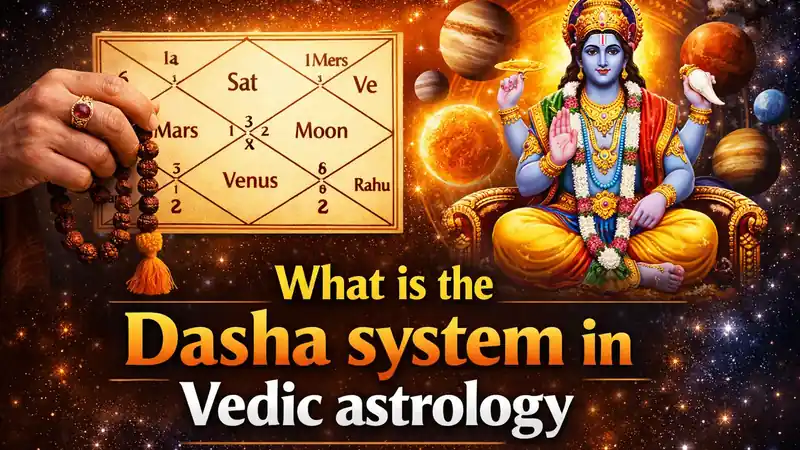
So what is the Dasha system in Vedic astrology in simple words? It is a sequence of planetary periods. Each major stretch of life is ruled by one planet, and that planet becomes a key time lord for that period. This is why people with similar birth charts can still go through very different experiences at the same age. The birth chart shows the promise, but Dasha shows the active timing. If someone asks, “Why did things suddenly change this year?” or “Why did a certain area of life become intense now?” the answer often starts with the running Mahadasha and Antardasha.
Dasha Meaning in Astrology
The dasha meaning in astrology is essentially a planetary phase of life. A Mahadasha is the main period, and inside it come smaller sub-periods called Antardashas. Those sub-periods refine the story. A person may be in Jupiter Mahadasha but Saturn Antardasha, or Moon Mahadasha but Rahu Antardasha, and that combination changes the tone. That is why Dasha reading is not just about one planet’s name. It is about the main period, the sub-period, and how both interact with the birth chart. When people say a planet is “running,” this is usually what they mean.
Which Mahadasha Comes First?
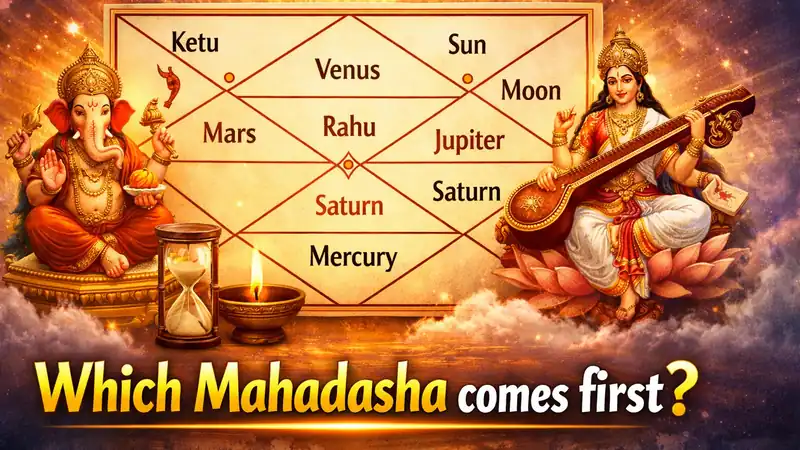
A very common question is: Which Mahadasha comes first? In the Vimshottari system, the first Mahadasha is decided by the nakshatra occupied by the Moon at birth. If the Moon is in Ashwini, the life begins in Ketu Mahadasha. If the Moon is in Bharani, it begins in Venus Mahadasha. If the Moon is in Rohini, it begins in Moon Mahadasha. But there is an important detail many people miss. No one is guaranteed to begin from the full first Mahadasha. The Moon may already have traveled part of that nakshatra, so only the remaining portion of that planetary period is left at birth. That remaining part is called the Dasha balance at birth.
Dasha Order in Astrology
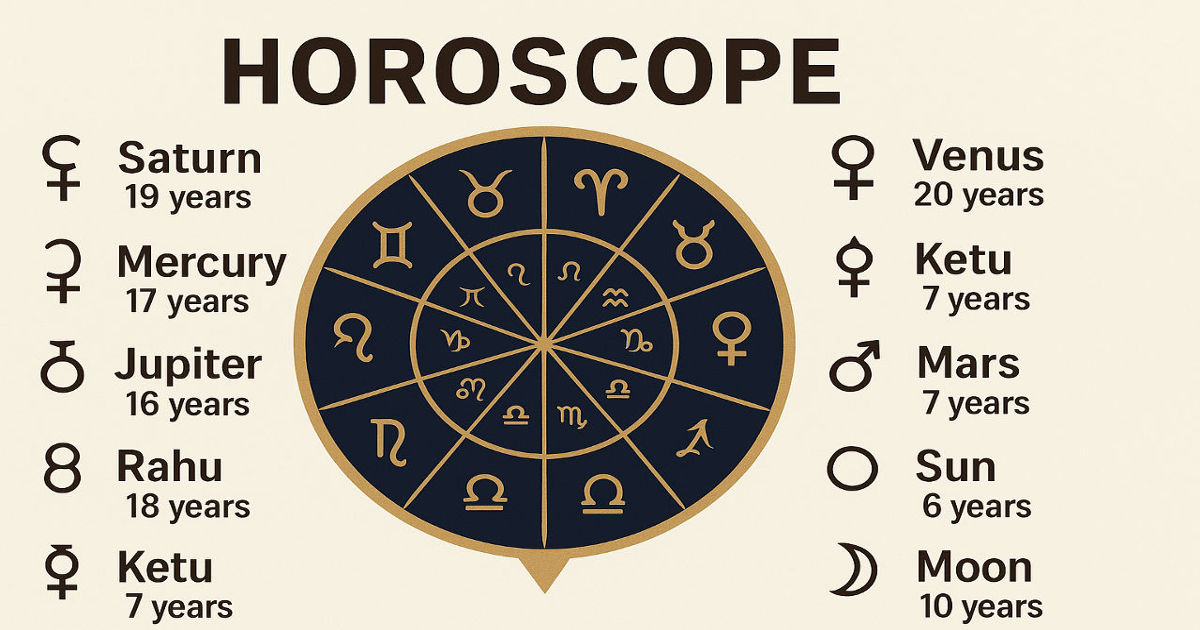
The dasha order in astrology under Vimshottari is fixed, and this is one of the most important things to understand clearly. The sequence is: Ketu, Venus, Sun, Moon, Mars, Rahu, Jupiter, Saturn, Mercury. Their standard Mahadasha lengths are also fixed: Ketu 7 years, Venus 20 years, Sun 6 years, Moon 10 years, Mars 7 years, Rahu 18 years, Jupiter 16 years, Saturn 19 years, and Mercury 17 years, completing a total cycle of 120 years. So when someone asks, “Which Mahadasha comes after mine?” the order does not change. What changes from person to person is the point in the sequence where life begins.
Dasa Period for Each Nakshatra
People also search for the dasa period for each nakshatra, because that is how the starting Mahadasha is actually identified. The 27 nakshatras are grouped under 9 planetary rulers, with 3 nakshatras for each planet. Ashwini, Magha, and Mula belong to Ketu; Bharani, Purva Phalguni, and Purva Ashadha belong to Venus; Krittika, Uttara Phalguni, and Uttara Ashadha belong to Sun; Rohini, Hasta, and Shravana belong to Moon; Mrigashira, Chitra, and Dhanishta belong to Mars; Ardra, Swati, and Shatabhisha belong to Rahu; Punarvasu, Vishakha, and Purva Bhadrapada belong to Jupiter; Pushya, Anuradha, and Uttara Bhadrapada belong to Saturn; and Ashlesha, Jyeshtha, and Revati belong to Mercury. Once the Moon’s birth nakshatra is known, the first Mahadasha becomes much easier to identify.
How Do I Know Which Mahadasha Is Going On?
Another major search question is: How do I know which Mahadasha is going on? The practical answer is simple. You need the birth date, exact birth time, and place of birth. From there, the Moon’s nakshatra at birth is calculated. Then the ruling planet of that nakshatra is identified. After that, the remaining balance of the first Mahadasha is worked out according to how far the Moon had already moved within that nakshatra. From that point, the full Dasha timeline is built in sequence. This is why people often get confused when they only know their Moon sign but not the exact nakshatra or accurate birth time. Even a small error in birth data can affect Dasha timing enough to create confusion about which Mahadasha or Antardasha is actually running.
Types of Dasha in Astrology
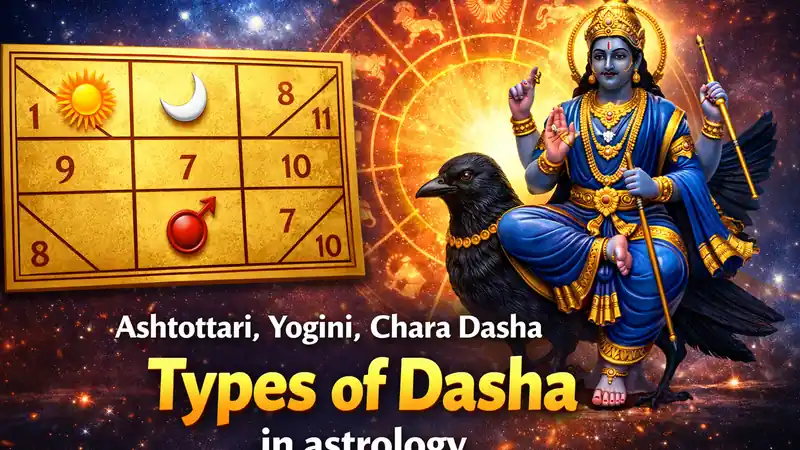
When people ask about types of Dasha in astrology, they are usually trying to understand whether all astrologers use the same system. The answer is no. Vimshottari Dasha is the most commonly used and most widely recognized system for timing in Vedic astrology, but it is not the only one. Traditional astrology also refers to other Dasha systems such as Ashtottari, Yogini, and Chara Dasha. So why do different astrologers sometimes mention different Dashas for the same chart? Because some systems are used for broader timing, some for specific traditions, and some depending on the method being followed. Even then, for general public understanding, Vimshottari remains the most familiar starting point.
Which Mahadasha Is Worst?
One of the most emotionally charged searches is: Which Mahadasha is worst? The honest answer is that there is no universally worst Mahadasha. Rahu Mahadasha, Saturn Mahadasha, or Ketu Mahadasha often get labeled as difficult because they can bring pressure, uncertainty, karmic turning points, delays, or detachment. But that does not mean they are always negative. A strong Saturn can build long-term stability. A powerful Rahu can bring sudden rise, foreign links, ambition, and worldly breakthroughs. A weak or afflicted Venus, Moon, or Jupiter can also give difficult results if they are poorly placed or tied to challenging houses. So the better question is not “Which Mahadasha is worst?” but “How is this Mahadasha functioning in this chart?” That is where meaningful interpretation begins.
Why Mahadasha Results Differ from Person to Person
This is also why people should avoid reading Mahadasha results in a generic, one-line way. The Dasha lord matters, but so do its house placement, condition, conjunctions, aspects, nakshatra connection, and the running Antardasha. A Jupiter period can feel protective for one person and heavy for another. A Moon period can bring peace in one chart and emotional turbulence in another. If you have ever wondered why a supposedly “good” Mahadasha did not feel good, or why a feared Mahadasha still gave progress, the answer usually lies in chart-specific factors rather than the planet’s reputation alone.
Why the Vedic Astrology Dasha System Matters
The real value of the vedic astrology dasha system is that it helps organize life timing with more precision than broad horoscope language. It tells you which planetary agenda is active, which themes are likely to rise, and why one period feels so different from the last. If you are trying to understand your current Mahadasha, the first step is not guessing which planet sounds strongest. It is checking the Moon’s birth nakshatra, the Dasha balance at birth, and the current Mahadasha-Antardasha sequence correctly. When important decisions are already pressing and confusion about timing is delaying action, getting the Dasha sequence properly examined by an experienced astrologer can bring clarity before the next phase begins.
Frequently Asked Questions
These common questions cover the basics of Mahadasha, nakshatra-based timing, and how the Dasha system is understood in Vedic astrology.
What is the Dasha system in Vedic astrology?
The Dasha system in Vedic astrology is a sequence of planetary periods that helps determine when specific life events and themes become active. Instead of reading the birth chart as a static picture, the Dasha system explains when a planet becomes strong enough to deliver its results, whether related to career, marriage, money, health, or personal growth.
Which Mahadasha comes first?
The first Mahadasha is determined by the nakshatra occupied by the Moon at birth. Each nakshatra is ruled by a specific planet, and that planet becomes the starting Mahadasha. However, the full Mahadasha does not always begin at birth, as only the remaining portion of the period based on the Moon’s position in that nakshatra is experienced first.
How do I know which Mahadasha is going on?
To know which Mahadasha is going on, you need your birth date, exact birth time, and place of birth. The Moon’s nakshatra at birth is calculated, its ruling planet is identified, and the remaining balance of the first Mahadasha is determined. From there, the full sequence of Mahadashas and Antardashas is mapped in order.
What is the Dasha order in astrology?
The Dasha order in the Vimshottari system is fixed as Ketu, Venus, Sun, Moon, Mars, Rahu, Jupiter, Saturn, and Mercury. Each planet has a specific duration, and together they complete a 120-year cycle. The order does not change, but the starting point depends on the Moon’s nakshatra at birth.
What is the Dasha meaning in astrology?
The Dasha meaning in astrology refers to a planetary phase of life. A Mahadasha is the main period, and within it are smaller sub-periods called Antardashas. These periods show how planetary influences unfold over time and how different life areas become active during specific phases.
What are the types of Dasha in astrology?
There are multiple types of Dasha systems in astrology, with Vimshottari Dasha being the most commonly used. Other systems include Ashtottari Dasha, Yogini Dasha, and Chara Dasha. Different systems may be used depending on the method or tradition being followed.
Which Mahadasha is worst?
There is no universally worst Mahadasha. While Rahu, Saturn, and Ketu Mahadashas are often considered challenging, their results depend on the individual birth chart. A strong planet can give positive outcomes even in traditionally difficult periods, while a weak or afflicted planet can create challenges even in generally favorable Mahadashas.
How is the Dasa period for each nakshatra determined?
The Dasa period for each nakshatra is determined by its ruling planet. The 27 nakshatras are divided into groups of three, each governed by one of the nine planets. The planet ruling the Moon’s nakshatra at birth decides the starting Mahadasha and its duration.
Hindi Transcript (हिंदी प्रतिलेख)
वैदिक ज्योतिष दशा प्रणाली: अर्थ, क्रम, महादशा, और अपनी वर्तमान अवधि कैसे जानें
जब लोग vedic astrology dasha system खोजते हैं, तो वे आमतौर पर एक ही चीज जानना चाहते हैं: समय। जीवन का एक चरण तेजी से क्यों गुजरता है, जबकि दूसरा देरी भरा, भारी, या असामान्य रूप से महत्वपूर्ण क्यों लगता है? वैदिक ज्योतिष में, दशा प्रणाली वह समय-ढांचा है जिसके माध्यम से समझा जाता है कि कोई ग्रह कब इतना सक्रिय होता है कि वह अपने परिणाम देना शुरू करे। पूरी कुंडली को एक सपाट चित्र की तरह पढ़ने के बजाय, दशा यह समझाती है कि कब कुछ विषय अधिक मजबूत होते हैं, चाहे वे करियर, विवाह, धन, स्वास्थ्य, शिक्षा, या आंतरिक परिवर्तन से जुड़े हों। इसका सबसे अधिक प्रचलित रूप विंशोत्तरी दशा है, जो जन्म के समय चंद्रमा के नक्षत्र पर आधारित 120 वर्ष का चक्र है।
वैदिक ज्योतिष में दशा प्रणाली क्या है?
तो सरल शब्दों में वैदिक ज्योतिष में दशा प्रणाली क्या है? यह ग्रहों की अवधियों का एक क्रम है। जीवन का प्रत्येक बड़ा चरण एक ग्रह द्वारा शासित होता है, और वह ग्रह उस अवधि का प्रमुख समय-स्वामी बन जाता है। यही कारण है कि समान जन्मकुंडली वाले लोग भी एक ही उम्र में बहुत अलग अनुभवों से गुजर सकते हैं। जन्मकुंडली संभावना दिखाती है, लेकिन दशा सक्रिय समय दिखाती है। यदि कोई पूछे, “इस साल अचानक इतना बदलाव क्यों आया?” या “जीवन का कोई एक क्षेत्र अभी इतना तीव्र क्यों हो गया?” तो उसका उत्तर अक्सर चल रही महादशा और अंतर्दशा से शुरू होता है।
ज्योतिष में दशा का अर्थ
dasha meaning in astrology मूल रूप से जीवन का एक ग्रहाधारित चरण है। महादशा मुख्य अवधि होती है, और उसके भीतर छोटी उप-अवधियाँ आती हैं जिन्हें अंतर्दशा कहा जाता है। ये उप-अवधियाँ कहानी को और स्पष्ट करती हैं। कोई व्यक्ति गुरु महादशा में हो सकता है लेकिन शनि अंतर्दशा में, या चंद्र महादशा में लेकिन राहु अंतर्दशा में, और यह संयोजन परिणामों का स्वभाव बदल देता है। यही कारण है कि दशा-पाठ केवल किसी एक ग्रह के नाम तक सीमित नहीं होता। यह मुख्य अवधि, उप-अवधि, और दोनों का जन्मकुंडली से संबंध समझने का विषय है। जब लोग कहते हैं कि कोई ग्रह “चल रहा है”, तो आमतौर पर उनका यही मतलब होता है।
सबसे पहले कौन-सी महादशा आती है?
एक बहुत सामान्य प्रश्न है: सबसे पहले कौन-सी महादशा आती है? विंशोत्तरी प्रणाली में पहली महादशा का निर्णय जन्म के समय चंद्रमा जिस नक्षत्र में स्थित हो उससे होता है। यदि चंद्रमा अश्विनी में है, तो जीवन केतु महादशा से शुरू होता है। यदि चंद्रमा भरणी में है, तो यह शुक्र महादशा से शुरू होता है। यदि चंद्रमा रोहिणी में है, तो यह चंद्र महादशा से शुरू होता है। लेकिन यहाँ एक महत्वपूर्ण बात है जिसे बहुत लोग नहीं समझते। किसी का जीवन पहली महादशा की पूरी अवधि से शुरू होना तय नहीं होता। चंद्रमा उस नक्षत्र का कुछ भाग पहले ही पार कर चुका हो सकता है, इसलिए जन्म के समय उस ग्रह-अवधि का केवल शेष भाग ही बचता है। इसी शेष भाग को जन्म के समय दशा शेष कहा जाता है।
ज्योतिष में दशा का क्रम
dasha order in astrology विंशोत्तरी में स्थिर होता है, और इसे स्पष्ट रूप से समझना बहुत जरूरी है। इसका क्रम है: केतु, शुक्र, सूर्य, चंद्र, मंगल, राहु, गुरु, शनि, बुध। इनकी मानक महादशा अवधियाँ भी स्थिर होती हैं: केतु 7 वर्ष, शुक्र 20 वर्ष, सूर्य 6 वर्ष, चंद्र 10 वर्ष, मंगल 7 वर्ष, राहु 18 वर्ष, गुरु 16 वर्ष, शनि 19 वर्ष, और बुध 17 वर्ष, जो मिलकर कुल 120 वर्ष का चक्र पूरा करती हैं। इसलिए जब कोई पूछता है, “मेरी महादशा के बाद कौन-सी महादशा आएगी?” तो उसका क्रम नहीं बदलता। जो चीज व्यक्ति-व्यक्ति में बदलती है, वह यह है कि जीवन इस क्रम के किस बिंदु से शुरू होता है।
प्रत्येक नक्षत्र के लिए दशा अवधि
लोग dasa period for each nakshatra भी खोजते हैं, क्योंकि इसी के माध्यम से यह पहचाना जाता है कि प्रारंभिक महादशा कौन-सी होगी। 27 नक्षत्र 9 ग्रहों के अधीन समूहित होते हैं, और प्रत्येक ग्रह के अधीन 3 नक्षत्र आते हैं। अश्विनी, मघा, और मूल केतु के अधीन हैं; भरणी, पूर्वा फाल्गुनी, और पूर्वाषाढ़ा शुक्र के अधीन हैं; कृत्तिका, उत्तर फाल्गुनी, और उत्तराषाढ़ा सूर्य के अधीन हैं; रोहिणी, हस्त, और श्रवण चंद्र के अधीन हैं; मृगशीर्षा, चित्रा, और धनिष्ठा मंगल के अधीन हैं; आर्द्रा, स्वाति, और शतभिषा राहु के अधीन हैं; पुनर्वसु, विशाखा, और पूर्व भाद्रपद गुरु के अधीन हैं; पुष्य, अनुराधा, और उत्तर भाद्रपद शनि के अधीन हैं; और आश्लेषा, ज्येष्ठा, और रेवती बुध के अधीन हैं। जब जन्म के समय चंद्रमा का नक्षत्र ज्ञात हो जाता है, तब पहली महादशा की पहचान काफी आसान हो जाती है।
मुझे कैसे पता चले कि कौन-सी महादशा चल रही है?
एक और बड़ा खोज-प्रश्न है: मुझे कैसे पता चले कि कौन-सी महादशा चल रही है? इसका व्यावहारिक उत्तर सरल है। आपको जन्मतिथि, सही जन्म समय, और जन्मस्थान चाहिए। इसके बाद जन्म के समय चंद्रमा का नक्षत्र निकाला जाता है। फिर उस नक्षत्र के स्वामी ग्रह की पहचान की जाती है। उसके बाद यह गणना की जाती है कि चंद्रमा उस नक्षत्र में कितना आगे बढ़ चुका था, और उसी के आधार पर पहली महादशा का शेष भाग निकाला जाता है। वहीं से पूरी दशा-रेखा क्रम में तैयार होती है। यही कारण है कि लोग अक्सर भ्रमित हो जाते हैं जब उन्हें केवल अपनी चंद्र राशि पता होती है, लेकिन सही नक्षत्र या सटीक जन्म समय नहीं पता होता। जन्म-जानकारी में छोटी-सी गलती भी दशा के समय को इतना प्रभावित कर सकती है कि यह स्पष्ट न रहे कि वास्तव में कौन-सी महादशा या अंतर्दशा चल रही है।
ज्योतिष में दशा के प्रकार
जब लोग types of Dasha in astrology के बारे में पूछते हैं, तो वे आमतौर पर यह समझना चाहते हैं कि क्या सभी ज्योतिषी एक ही प्रणाली का उपयोग करते हैं। उत्तर है, नहीं। विंशोत्तरी दशा वैदिक ज्योतिष में समय-निर्धारण के लिए सबसे अधिक उपयोग की जाने वाली और सबसे व्यापक रूप से पहचानी जाने वाली प्रणाली है, लेकिन यह अकेली प्रणाली नहीं है। पारंपरिक ज्योतिष में अन्य दशा प्रणालियों का भी उल्लेख मिलता है, जैसे अष्टोत्तरी, योगिनी, और चर दशा। तो फिर अलग-अलग ज्योतिषी एक ही कुंडली के लिए अलग-अलग दशाओं का उल्लेख क्यों करते हैं? क्योंकि कुछ प्रणालियाँ व्यापक समय-निर्धारण के लिए उपयोग होती हैं, कुछ विशिष्ट परंपराओं के लिए, और कुछ अपनाई गई पद्धति पर निर्भर करती हैं। फिर भी, सामान्य समझ के लिए विंशोत्तरी सबसे परिचित प्रारंभिक बिंदु बनी रहती है।
कौन-सी महादशा सबसे खराब होती है?
सबसे भावनात्मक खोजों में से एक है: कौन-सी महादशा सबसे खराब होती है? इसका ईमानदार उत्तर है कि कोई भी महादशा सार्वभौमिक रूप से सबसे खराब नहीं होती। राहु महादशा, शनि महादशा, या केतु महादशा को अक्सर कठिन माना जाता है, क्योंकि वे दबाव, अनिश्चितता, कर्मजन्य मोड़, देरी, या विरक्ति ला सकती हैं। लेकिन इसका मतलब यह नहीं कि वे हमेशा नकारात्मक ही हों। मजबूत शनि दीर्घकालिक स्थिरता बना सकता है। शक्तिशाली राहु अचानक उन्नति, विदेश संबंध, महत्वाकांक्षा, और सांसारिक उपलब्धियाँ दे सकता है। यदि शुक्र, चंद्र, या गुरु कमजोर हों या कठिन भावों से जुड़े हों, तो वे भी चुनौतीपूर्ण परिणाम दे सकते हैं। इसलिए बेहतर प्रश्न यह नहीं है कि “कौन-सी महादशा सबसे खराब है?” बल्कि यह है कि “यह महादशा इस कुंडली में कैसे कार्य कर रही है?” यहीं से सार्थक व्याख्या शुरू होती है।
महादशा के परिणाम व्यक्ति-व्यक्ति में अलग क्यों होते हैं?
यही कारण है कि लोगों को महादशा के परिणामों को एक सामान्य, एक-पंक्ति वाले तरीके से नहीं पढ़ना चाहिए। दशा स्वामी महत्वपूर्ण है, लेकिन उसका भाव स्थान, स्थिति, युति, दृष्टि, नक्षत्र संबंध, और चल रही अंतर्दशा भी उतनी ही महत्वपूर्ण होती है। किसी एक व्यक्ति के लिए गुरु की अवधि संरक्षण देने वाली हो सकती है, जबकि दूसरे के लिए वही भारी लग सकती है। एक कुंडली में चंद्र की अवधि शांति ला सकती है, तो दूसरी में भावनात्मक अस्थिरता। यदि आपने कभी सोचा है कि कोई तथाकथित “अच्छी” महादशा अच्छी क्यों नहीं लगी, या किसी डरी हुई महादशा में भी प्रगति क्यों मिली, तो उसका उत्तर अक्सर उस ग्रह की सामान्य प्रतिष्ठा में नहीं, बल्कि कुंडली-विशेष कारकों में छिपा होता है।
वैदिक ज्योतिष दशा प्रणाली क्यों महत्वपूर्ण है?
vedic astrology dasha system का वास्तविक महत्व यह है कि यह जीवन के समय को सामान्य राशिफल भाषा की तुलना में अधिक स्पष्ट तरीके से व्यवस्थित करती है। यह बताती है कि अभी कौन-सा ग्रह-अजेंडा सक्रिय है, कौन-से विषय उभर सकते हैं, और क्यों एक अवधि पिछली अवधि से इतनी अलग महसूस होती है। यदि आप अपनी वर्तमान महादशा को समझने की कोशिश कर रहे हैं, तो पहला कदम यह नहीं होना चाहिए कि कौन-सा ग्रह सबसे मजबूत लग रहा है। पहला कदम यह है कि जन्म के समय चंद्रमा का नक्षत्र, जन्म के समय दशा शेष, और वर्तमान महादशा-अंतर्दशा क्रम को सही तरीके से जांचा जाए। जब महत्वपूर्ण निर्णय सामने हों और समय को लेकर भ्रम कार्रवाई में देरी कर रहा हो, तब दशा क्रम की सही जांच किसी अनुभवी ज्योतिषी से कराना अगला चरण शुरू होने से पहले स्पष्टता दे सकता है।
Hindi FAQs
वैदिक ज्योतिष में दशा प्रणाली क्या है?
वैदिक ज्योतिष में दशा प्रणाली ग्रहों की अवधियों का एक क्रम है, जो यह निर्धारित करने में मदद करता है कि जीवन की कौन-सी घटनाएँ और विषय कब सक्रिय होंगे। जन्मकुंडली को एक स्थिर चित्र की तरह पढ़ने के बजाय, दशा प्रणाली यह समझाती है कि कोई ग्रह कब इतना मजबूत होता है कि वह अपने परिणाम देना शुरू करे, चाहे वह करियर, विवाह, धन, स्वास्थ्य या व्यक्तिगत विकास से जुड़ा हो।
सबसे पहले कौन-सी महादशा आती है?
पहली महादशा का निर्धारण जन्म के समय चंद्रमा जिस नक्षत्र में होता है, उससे होता है। प्रत्येक नक्षत्र एक विशेष ग्रह द्वारा शासित होता है, और वही ग्रह प्रारंभिक महादशा बनता है। हालांकि, पूरी महादशा जन्म से शुरू नहीं होती, क्योंकि उस नक्षत्र में चंद्रमा की स्थिति के अनुसार केवल शेष अवधि ही पहले अनुभव की जाती है।
मुझे कैसे पता चले कि कौन-सी महादशा चल रही है?
यह जानने के लिए कि कौन-सी महादशा चल रही है, आपको अपनी जन्मतिथि, सटीक जन्म समय और जन्म स्थान की आवश्यकता होती है। जन्म के समय चंद्रमा का नक्षत्र निकाला जाता है, उसके स्वामी ग्रह की पहचान की जाती है, और पहली महादशा का शेष भाग निर्धारित किया जाता है। इसके बाद महादशाओं और अंतर्दशाओं का पूरा क्रम क्रमबद्ध तरीके से तैयार किया जाता है।
ज्योतिष में दशा का क्रम क्या है?
विंशोत्तरी प्रणाली में दशा का क्रम स्थिर होता है: केतु, शुक्र, सूर्य, चंद्र, मंगल, राहु, गुरु, शनि और बुध। प्रत्येक ग्रह की एक निश्चित अवधि होती है, और ये सभी मिलकर 120 वर्ष का चक्र पूरा करते हैं। यह क्रम नहीं बदलता, लेकिन इसकी शुरुआत चंद्रमा के जन्म नक्षत्र पर निर्भर करती है।
ज्योतिष में दशा का अर्थ क्या है?
ज्योतिष में दशा का अर्थ जीवन का एक ग्रहाधारित चरण होता है। महादशा मुख्य अवधि होती है, और उसके भीतर छोटी उप-अवधियाँ होती हैं जिन्हें अंतर्दशा कहा जाता है। ये अवधियाँ यह दर्शाती हैं कि समय के साथ ग्रहों का प्रभाव कैसे विकसित होता है और जीवन के अलग-अलग क्षेत्र कब सक्रिय होते हैं।
ज्योतिष में दशा के प्रकार क्या हैं?
ज्योतिष में कई प्रकार की दशा प्रणालियाँ होती हैं, जिनमें विंशोत्तरी दशा सबसे अधिक प्रचलित है। अन्य प्रणालियों में अष्टोत्तरी दशा, योगिनी दशा और चर दशा शामिल हैं। अलग-अलग पद्धतियों या परंपराओं के अनुसार विभिन्न दशाओं का उपयोग किया जा सकता है।
कौन-सी महादशा सबसे खराब होती है?
कोई भी महादशा सार्वभौमिक रूप से सबसे खराब नहीं होती। हालांकि राहु, शनि और केतु महादशाओं को अक्सर चुनौतीपूर्ण माना जाता है, लेकिन उनके परिणाम व्यक्ति की जन्मकुंडली पर निर्भर करते हैं। एक मजबूत ग्रह कठिन मानी जाने वाली अवधि में भी सकारात्मक परिणाम दे सकता है, जबकि एक कमजोर या प्रभावित ग्रह सामान्यतः अच्छी मानी जाने वाली महादशा में भी समस्याएँ पैदा कर सकता है।
प्रत्येक नक्षत्र के लिए दशा अवधि कैसे निर्धारित होती है?
प्रत्येक नक्षत्र की दशा अवधि उसके स्वामी ग्रह द्वारा निर्धारित होती है। 27 नक्षत्रों को तीन-तीन के समूह में नौ ग्रहों के अधीन विभाजित किया गया है। जन्म के समय चंद्रमा जिस नक्षत्र में होता है, उसका स्वामी ग्रह प्रारंभिक महादशा और उसकी अवधि तय करता है।