Vedic Astrology: Birth Charts, Grahas and Dashas
A birth chart is more than a list of planets. In the traditional Indian practice of Jyotisha, astrologers examine the ascendant, houses, grahas and planetary periods together to discuss the themes a person may be facing. This guide introduces those building blocks, explains how they fit together and highlights the limits of HOROSCOPE GUIDANCE interpretations.
Begin with the central distinction: a horoscope describes a traditional interpretive framework, not a guarantee of future events. Useful consultation questions are specific—such as how to evaluate a career transition or relationship concern—and should be answered with the whole chart in view.
What is Vedic astrology?
Vedic astrology, also called Jyotisha, is a traditional Indian system for interpreting celestial positions in relation to a person’s birth. A birth chart, or janma kundali, maps the zodiac, the ascendant and nine grahas for a particular date, time and place. Practitioners use this symbolic framework to discuss temperament, life themes and the timing of possible developments. It is a cultural and interpretive tradition, not a scientifically established method of predicting individual events.
For background on the development of the tradition, see our history of Vedic Astrology. Its history and the modern use of Jyotisha are distinct topics from the practical reading process described here.
How a birth chart is constructed
The ascendant (Lagna) is the zodiac sign rising at the eastern horizon at the moment of birth. The twelve houses (bhavas) organise subjects such as family, education, work and relationships. Each graha occupies a sign and is interpreted according to its house, sign, rulership and associations. Even a small error in recorded birth time can change the rising sign or sensitive house positions, so accurate birth details matter.
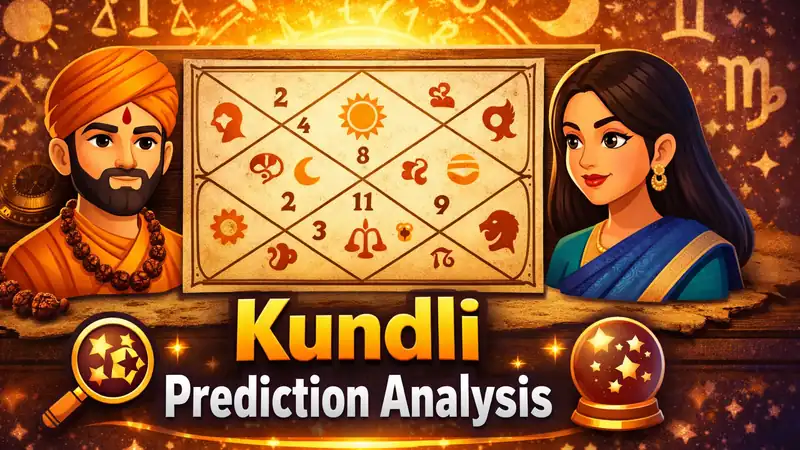
The whole-chart approach matters because one placement cannot be assessed fairly without examining the house it occupies, its lordship and the wider pattern of influences.
The nine grahas and their meanings
The classical nine grahas are Surya (Sun), Chandra (Moon), Mangala (Mars), Budha (Mercury), Guru (Jupiter), Shukra (Venus), Shani (Saturn), Rahu and Ketu. The last two are lunar nodes rather than physical planets. In traditional readings the Sun is associated with identity and authority; the Moon with the mind; Mercury with communication; Venus with relationships; Jupiter with learning; Mars with initiative; Saturn with discipline; and Rahu and Ketu with unfamiliar experiences and detachment. No single graha supplies a complete answer.
Rahu and Ketu are mathematically defined lunar nodes in this framework, not physical planets. The nine grahas are therefore a traditional set of interpretive factors rather than nine identical kinds of astronomical objects.
Rashi, bhava and nakshatra: three different layers
Rashi means a zodiac sign, bhava refers to a house, and nakshatra is one of 27 lunar divisions used in many Jyotisha traditions. A planet’s sign describes a style of expression, its house indicates a life domain, and the nakshatra offers another traditional layer of interpretation. For example, discussing the tenth house of profession requires looking beyond the sign alone to its lord and relevant influences.
A sign and a house are not interchangeable. Houses identify the area under discussion; signs and graha relationships help characterise its interpretation. This distinction is especially useful when comparing two charts that share a Moon sign but have different rising signs.
What are dashas and transits?
Vimshottari Dasha is a widely used planetary-period system, traditionally calculated from the Moon’s birth nakshatra. Mahadasha, antardasha and finer subdivisions provide a sequence of periods for interpretation. Transits (gochara) describe the changing positions of grahas relative to the natal chart. Astrologers commonly consider dasha and transit together, but neither guarantees that a specific event will occur on a predicted date.
Vimshottari timings are usually presented in major, sub- and finer periods. A careful discussion explains which calculation convention is being used and avoids turning an interpretive period into a promised event date.
Navamsha, yogas and careful interpretation
Some practitioners examine divisional charts, particularly the D9 Navamsha, alongside the main D1 chart. They may also consider yogas: specific combinations of grahas, houses and lordships. A named yoga does not automatically promise success or difficulty. Its relevance is assessed within the full chart, and different Jyotisha schools may apply different interpretive rules.
When discussing challenging patterns, it also helps to distinguish the broader chart judgement from a named dosha. Our guide to dosha types explains those terms separately.
A practical example: thinking about career decisions
Suppose someone is considering a job change. A traditional reading might explore the tenth house for professional responsibilities, the sixth for employment and routine, the second and eleventh for resources and gains, and the current planetary periods for themes of transition. That discussion can help someone organise questions to consider. The actual decision should still depend on skills, financial circumstances, professional advice and available opportunities—not astrology alone.

For a career decision, a practitioner may examine the tenth, sixth, second and eleventh houses together. The reading should clarify questions and alternatives; it cannot substitute for professional judgement or actual opportunities.
When a consultation may be useful
People often seek a Vedic astrology consultation to discuss career direction, relationships, marriage compatibility or a difficult life transition. A responsible consultation begins by confirming birth details, clarifying the question and explaining the method and uncertainty. It should never create fear, claim guaranteed outcomes or pressure someone into expensive remedies. For matching traditions, you can explore our love compatibility calculator as a separate educational tool.
A useful appointment should make the method understandable, respect your independence and avoid claims of certainty or pressure to buy additional services.
Limits, choice and personal responsibility
Vedic astrology is best presented as a traditional interpretive practice. It should not replace medical diagnosis, legal counsel, investment guidance or mental-health support. You remain free to make choices irrespective of what a chart interpretation suggests. Consult an appropriately qualified professional for decisions with significant health, financial or legal consequences.
Frequently asked questions
Is Vedic astrology the same as a daily Sun-sign horoscope?
No. A personalised Jyotisha reading generally considers a birth time, ascendant, houses and planetary periods rather than only a Sun sign.
Can an inaccurate birth time affect the interpretation?
Yes. The ascendant and sensitive house positions depend on the recorded time and place of birth.
Do two people with the same Moon sign have identical charts?
No. The ascendant, houses, other grahas and planetary periods can differ substantially.
Are predicted outcomes certain?
No. These are traditional interpretations, not verified guarantees or substitutes for professional advice.
पूरा लेख हिंदी में पढ़ें — Hindi article translation
जन्मकुंडली केवल ग्रहों की सूची नहीं है। भारतीय ज्योतिष-परंपरा में लग्न, भाव, ग्रह और ग्रह-अवधियों को साथ देखकर जीवन के प्रश्नों पर विचार किया जाता है। इस लेख में इन मूल तत्वों, उनके आपसी संबंधों और कुंडली से की जाने वाली व्याख्या की सीमाओं को समझाया गया है।
कुंडली को भविष्य की घटनाओं की निश्चित गारंटी नहीं समझना चाहिए। करियर में बदलाव या संबंधों की उलझन जैसे प्रश्नों पर चर्चा करते समय पूरी कुंडली का संदर्भ महत्त्वपूर्ण होता है।
वैदिक ज्योतिष क्या है?
वैदिक ज्योतिष, जिसे ज्योतिष शास्त्र भी कहते हैं, भारत की एक पारंपरिक पद्धति है। इसमें जन्म के समय और स्थान के अनुसार राशियों, लग्न तथा नौ ग्रहों की स्थिति से जन्मकुंडली तैयार की जाती है। ज्योतिषी इस प्रतीकात्मक ढाँचे की सहायता से स्वभाव, जीवन के विषयों तथा संभावित समय-चक्रों पर विचार करते हैं। यह सांस्कृतिक और व्याख्यात्मक परंपरा है; व्यक्तिगत घटनाओं की भविष्यवाणी करने की वैज्ञानिक रूप से प्रमाणित विधि नहीं है।
इस परंपरा के विकास को समझने के लिए वैदिक ज्योतिष के इतिहास का अलग लेख उपयोगी हो सकता है। यहाँ हमारा मुख्य विषय कुंडली की व्याख्या करने की प्रक्रिया है।
जन्मकुंडली कैसे बनती है?
लग्न जन्म के क्षण पूर्वी क्षितिज पर उदित राशि को कहते हैं। बारह भाव परिवार, शिक्षा, काम और संबंध जैसे जीवन-विषयों का ढाँचा देते हैं। प्रत्येक ग्रह की राशि, भाव, स्वामित्व और दूसरे ग्रहों से संबंध देखकर अर्थ निकाला जाता है। जन्म-समय में थोड़ी त्रुटि भी लग्न या कुछ भावों की स्थिति बदल सकती है; इसलिए सही जन्म-विवरण महत्त्वपूर्ण है।
एक ग्रह की स्थिति को उसके भाव, स्वामित्व और अन्य ग्रहों के संबंध से अलग रखकर अंतिम निर्णय नहीं करना चाहिए। पूरी कुंडली देखने से विषय का व्यापक संदर्भ मिलता है।
नौ ग्रहों का अर्थ
परंपरागत नौ ग्रह सूर्य, चंद्रमा, मंगल, बुध, गुरु, शुक्र, शनि, राहु और केतु हैं। राहु और केतु भौतिक ग्रह नहीं, चंद्र-पथ के गणितीय नोड हैं। पारंपरिक व्याख्या में सूर्य आत्मपहचान और अधिकार, चंद्रमा मन, बुध संचार, शुक्र संबंध, गुरु ज्ञान, मंगल पहल, शनि अनुशासन और राहु-केतु असामान्य अनुभव तथा वैराग्य से जुड़े माने जाते हैं। केवल एक ग्रह से पूरी कुंडली का निर्णय नहीं किया जा सकता।
राहु और केतु इस पद्धति में गणितीय चंद्र-नोड हैं, भौतिक ग्रह नहीं। इसलिए नौ ग्रहों की पारंपरिक सूची में शामिल सभी तत्व एक ही प्रकार की खगोलीय वस्तुएँ नहीं हैं।
राशि, भाव और नक्षत्र
राशि राशि-चक्र का एक भाग है, भाव जीवन के क्षेत्र को बताता है और नक्षत्र चंद्र-पथ के 27 पारंपरिक विभागों में से एक है। किसी ग्रह की राशि उसकी अभिव्यक्ति, भाव उसका जीवन-क्षेत्र तथा नक्षत्र एक अतिरिक्त व्याख्यात्मक परत देता है। उदाहरण के लिए दशम भाव से व्यवसाय की चर्चा करते समय केवल राशि नहीं, उसके स्वामी और संबंधित प्रभावों को भी देखना होता है।
राशि और भाव एक ही चीज नहीं हैं। भाव यह बताता है कि चर्चा जीवन के किस क्षेत्र की है, जबकि राशि और ग्रहों के संबंध उसकी पारंपरिक व्याख्या में सहायक होते हैं। एक ही चंद्र राशि वाले व्यक्तियों के लग्न और भाव अलग हो सकते हैं।
दशा और गोचर क्या हैं?
विंशोत्तरी दशा ग्रह-अवधियों की एक प्रचलित प्रणाली है, जिसकी गणना सामान्यतः जन्म-नक्षत्र से की जाती है। महादशा, अंतर्दशा और छोटी उप-अवधियाँ समय की क्रमबद्ध व्याख्या का आधार बनती हैं। गोचर वर्तमान ग्रह-स्थितियों का जन्मकुंडली से संबंध दिखाता है। ज्योतिषी दशा और गोचर को साथ देख सकते हैं, पर इनके आधार पर किसी घटना की निश्चित तारीख की गारंटी नहीं दी जा सकती।
विंशोत्तरी दशा को महादशा, अंतर्दशा तथा छोटी अवधियों के क्रम में देखा जाता है। जिम्मेदार व्याख्या में गणना-पद्धति स्पष्ट होनी चाहिए और किसी घटना की तारीख निश्चित होने का दावा नहीं करना चाहिए।
नवांश, योग और सावधानीपूर्ण विवेचन
कुछ ज्योतिषी मुख्य D1 कुंडली के साथ नवांश D9 जैसी वर्ग-कुंडलियाँ भी देखते हैं। योग ग्रहों, भावों और स्वामित्व के विशिष्ट संबंधों को कहते हैं। किसी प्रसिद्ध योग का नाम अपने-आप सफलता या कठिनाई सुनिश्चित नहीं करता। उसका अर्थ पूरी कुंडली में जाँचा जाता है और अलग-अलग परंपराओं में नियम भिन्न हो सकते हैं।
किसी कठिन योग या दोष की चर्चा करते समय नाम मात्र को पूरी कुंडली के निर्णय के बराबर नहीं मानना चाहिए। दोषों के प्रकारों पर अलग परिचय इन शब्दों को समझने में सहायक हो सकता है।
करियर निर्णय का एक उदाहरण
मान लीजिए कोई व्यक्ति नौकरी बदलने पर विचार कर रहा है। पारंपरिक विश्लेषण में दशम भाव से पेशा, षष्ठ भाव से सेवा और दिनचर्या, द्वितीय व एकादश भाव से साधन व आय तथा वर्तमान दशाओं से बदलाव के विषयों पर चर्चा हो सकती है। ऐसी चर्चा सोच को व्यवस्थित करने में सहायक हो सकती है। वास्तविक निर्णय कौशल, आर्थिक स्थिति, पेशेवर सलाह और उपलब्ध अवसरों पर आधारित होना चाहिए—केवल ज्योतिष पर नहीं।
करियर पर चर्चा में दशम, षष्ठ, द्वितीय और एकादश भाव को साथ देखा जा सकता है। ऐसे विवेचन का उद्देश्य प्रश्नों और विकल्पों को स्पष्ट करना होना चाहिए; यह वास्तविक अवसरों या पेशेवर सलाह का विकल्प नहीं है।
परामर्श कब उपयोगी हो सकता है?
लोग करियर, संबंध, विवाह-संगति या जीवन में बदलाव पर चर्चा के लिए ज्योतिष परामर्श लेते हैं। जिम्मेदार परामर्श में जन्म-विवरण की पुष्टि, प्रश्न की स्पष्टता और अनिश्चितता का ईमानदार उल्लेख होना चाहिए। भय पैदा करना, परिणाम की गारंटी देना या महंगे उपायों के लिए दबाव डालना उचित नहीं है। विवाह-संगति के विषय में अलग शैक्षिक साधन के रूप में वेबसाइट का प्रेम-संगति कैलकुलेटर उपलब्ध है।
उपयोगी परामर्श में प्रश्न और जन्म-विवरण की पुष्टि, पद्धति की स्पष्ट व्याख्या, व्यक्ति की स्वतंत्रता का सम्मान तथा अनिश्चितता का ईमानदार उल्लेख होना चाहिए। परिणाम की गारंटी या अतिरिक्त सेवाएँ खरीदने का दबाव उचित नहीं है।
सीमाएँ और व्यक्तिगत जिम्मेदारी
वैदिक ज्योतिष को पारंपरिक व्याख्यात्मक अभ्यास के रूप में समझना चाहिए। यह चिकित्सा-जाँच, कानूनी परामर्श, निवेश सलाह या मानसिक-स्वास्थ्य सहायता का विकल्प नहीं है। कुंडली की कोई भी व्याख्या आपके निर्णय लेने की स्वतंत्रता समाप्त नहीं करती। स्वास्थ्य, धन या कानून से जुड़े महत्त्वपूर्ण निर्णयों के लिए योग्य विशेषज्ञ की सलाह लें।
अक्सर पूछे जाने वाले प्रश्न
क्या वैदिक ज्योतिष दैनिक सूर्य-राशि भविष्यफल जैसा है?
नहीं। व्यक्तिगत ज्योतिष-विवेचन में सामान्यतः जन्म-समय, लग्न, भाव और ग्रह-अवधियों को देखा जाता है।
क्या जन्म-समय गलत होने से व्याख्या बदल सकती है?
हाँ। लग्न तथा कुछ भावों की स्थिति जन्म के समय और स्थान पर निर्भर करती है।
क्या एक चंद्र राशि वाले दो व्यक्तियों की कुंडलियाँ समान होती हैं?
नहीं। उनके लग्न, भाव, अन्य ग्रहों की स्थितियाँ और दशाएँ काफी भिन्न हो सकती हैं।
क्या भविष्यवाणियों के परिणाम निश्चित होते हैं?
नहीं। ये पारंपरिक व्याख्याएँ हैं, निश्चित प्रमाणित परिणाम या विशेषज्ञ सलाह का विकल्प नहीं।