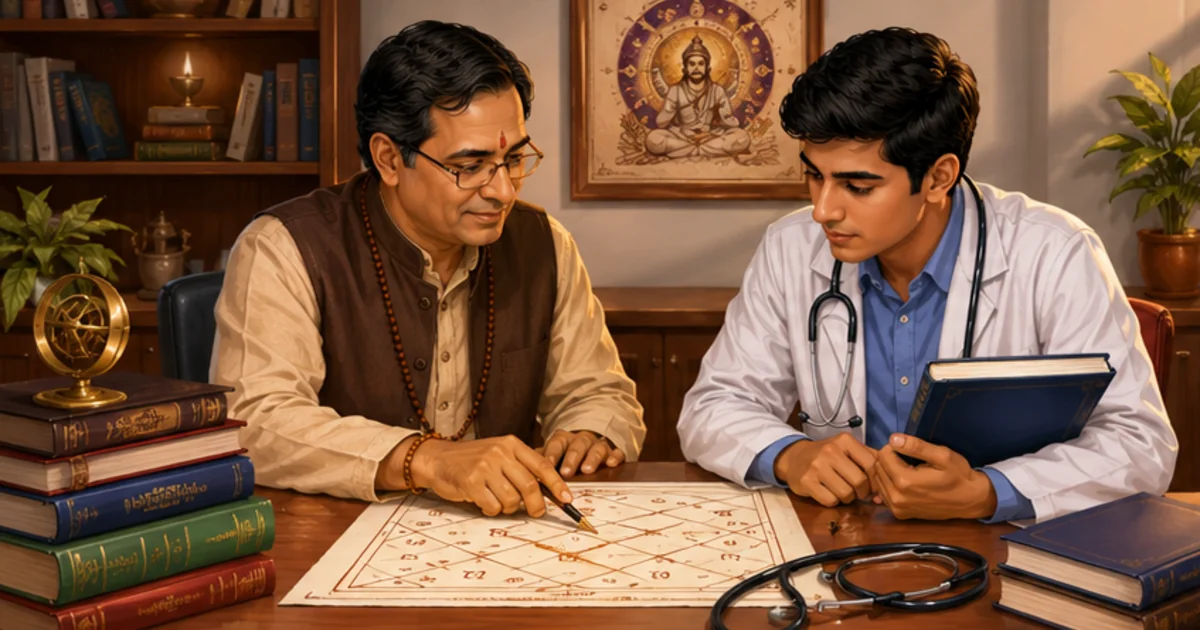
Astrological Yoga to Become a Doctor: What a Kundli Can Indicate
An astrological yoga to become a doctor is not one fixed planetary placement that guarantees entry into the medical profession. In Vedic astrology, medical-career potential is assessed by examining several houses, planets, planetary relationships, divisional charts and operating dashas together.
This question usually becomes important when a student is deciding whether medicine is the right career, preparing for a medical entrance examination or facing uncertainty after repeated delays. Parents may also search for doctor yoga in a kundli because they want to understand whether a child has the aptitude and long-term potential required for medical education.
General planetary combinations can provide direction, but they cannot replace academic performance, genuine interest, entrance qualifications, clinical training or sustained effort. A complete kundli may indicate potential, opportunities and suitable timing, but becoming a doctor ultimately requires both astrological support and real-world preparation.

What Is an Astrological Yoga to Become a Doctor?
In Vedic astrology, a yoga is formed when particular planets, houses or house lords become connected in a meaningful way. The connection may occur through placement, conjunction, aspect, exchange of signs or mutual influence.
A doctor yoga is therefore not a single planet sitting in a particular house. It is usually a combination involving education, intelligence, disease, healing, investigation, higher learning, service and profession.
For example, a chart may show strong educational ability but weak professional support. Another chart may show interest in medicine but difficulty completing a long course of study. A third chart may support a healthcare profession without specifically indicating work as a physician.
This is why isolated rules can be misleading. A person may have Mars connected with the eighth house, but that alone does not make the person a surgeon. The complete chart must show whether the combination supports education, technical skill, professional establishment and the ability to handle responsibility.
A genuine assessment also considers whether the same theme is repeated through different parts of the kundli. Repetition strengthens a possibility. A single unsupported indication may remain only a broad tendency.
Which Houses Are Examined for a Medical Career?
Several houses may become relevant when assessing a medical profession in a kundli. Their importance depends on how they interact rather than on one house operating alone.
The ascendant and its lord show the person’s general nature, physical constitution, direction and ability to carry the responsibilities of a demanding profession. A strong ascendant can support stamina, confidence and continuity of effort.
The fourth house is commonly examined for foundational education. Its condition may help an astrologer understand the student’s learning environment, educational stability and ability to complete the earlier stages of study.
The fifth house is associated with intelligence, memory, judgment, comprehension and examination ability. Medical education requires more than the capacity to memorise information. It also requires analysis, observation, decision-making and the ability to apply knowledge under pressure.
The sixth house has an important relationship with illness, service, treatment, competition and the practical management of health-related problems. Because doctors work with disease and provide service, the sixth house frequently becomes relevant in medical-career analysis.
For broader background on traditional health-house interpretations, see the Medical Astrology Guide.
However, a strong sixth house alone does not confirm that a person will become a doctor. It can also indicate many other forms of service, competition, employment, conflict management or work involving difficult conditions.
The eighth house is associated with hidden processes, research, emergencies, surgery, chronic conditions, investigation and subjects that require deep examination. Its relationship with medical indicators may become important for surgery, pathology, medical research or other specialised fields.
The ninth house represents higher education, advanced knowledge, mentors and long-term academic development. A medical degree requires years of structured study, and specialisation may require additional support from the ninth house.
The tenth house is the principal house of profession, status, responsibility and public work. Even when a chart supports medical education, the tenth house and its lord should connect meaningfully with the relevant educational and medical factors for the profession to become firmly established.
The eleventh house may indicate achievement, fulfilment of professional goals, income and recognition. It can show whether educational and career efforts are likely to produce practical results.
The twelfth house is traditionally connected with hospitals, institutions, isolation, foreign environments and work carried out behind the scenes. Its connection with the sixth, eighth or tenth house may become relevant in charts involving hospitals, laboratories, institutional medicine or medical work abroad.
A responsible judgment examines the strength of these houses, their lords, the planets occupying them and the aspects they receive. One house should never become the sole basis of a medical-career conclusion.
Which Planets Are Connected with Medicine and Healing?
Different planets represent different qualities needed in medicine. No single planet should be described as the only planet responsible for becoming a doctor.
The Sun may represent vitality, authority, confidence and the ability to hold responsibility. Its influence can be useful in professions where decisive judgment and professional standing are important.
The Moon is connected with care, emotional responsiveness, nourishment and sensitivity to the needs of others. A balanced Moon can support empathy and the ability to respond calmly to patients, although its role must be judged within the complete chart.
Mars represents courage, blood, sharp instruments, technical action and the ability to respond in urgent situations. It is frequently considered in relation to surgery and emergency medicine. However, an uncontrolled or severely afflicted Mars may also create impatience or excessive impulsiveness, so strength must be accompanied by balance.
Mercury represents intelligence, observation, calculation, communication and analytical ability. Diagnosis often requires attention to detail, interpretation of information and clear communication, making Mercury an important planet in many medical charts.
Jupiter represents knowledge, judgment, ethics, teaching and guidance. Its support may strengthen higher education, responsible decision-making and a constructive approach to healing.
Venus can become relevant in areas connected with reproduction, fertility, skin, beauty, comfort and restoration. Its meaning depends on the houses it owns, its condition and the other planets involved.
Saturn represents discipline, endurance, patience, chronic conditions and service performed over long periods. Medical education and practice require sustained effort, demanding schedules and the ability to remain committed despite delay or fatigue.
Rahu may indicate technology, complex investigation, unusual conditions, poisons, chemicals, foreign methods and modern equipment. Its influence can sometimes appear in charts connected with advanced diagnostics, research, pharmaceuticals or technology-based medical fields.
Ketu may represent precision, detachment, subtle investigation and the ability to work with specialised or hidden processes. In some combinations, it may contribute to surgical, diagnostic or research-oriented tendencies.
The meaning of every planet changes according to sign, house ownership, placement, conjunction, aspect, strength and dasha. The same planet can produce different professional outcomes in different kundlis.
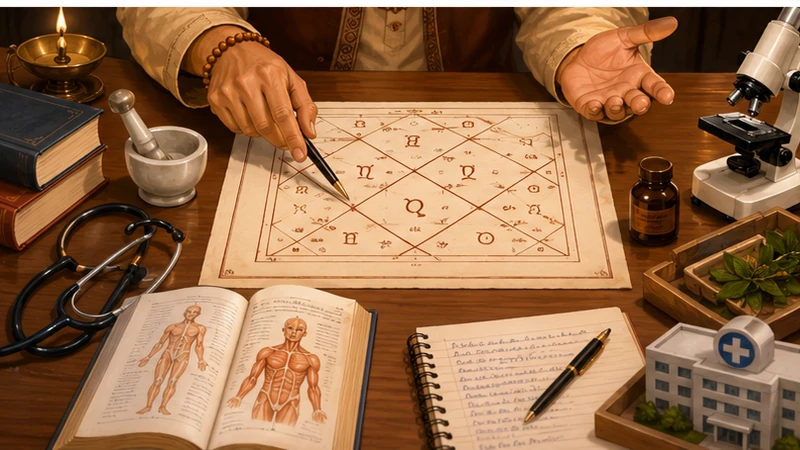
How Doctor Yogas Are Judged in the Full Kundli
A proper medical-career analysis begins by identifying whether education, intelligence, healing, service and profession are connected in a supportive way.
The astrologer may first assess the ascendant, the ascendant lord and the overall strength of the birth chart. A demanding profession is difficult to sustain when the chart shows interest but insufficient continuity, resilience or capacity to complete long training.
The fourth, fifth and ninth houses are examined for education. The sixth, eighth and twelfth houses may be examined for illness, treatment, investigation, hospitals and specialised medical environments. The tenth house is then assessed to determine whether these indications can become part of the person’s profession.
Connections between the lords of these houses may be significant. For example, a relationship between education and profession can support the conversion of knowledge into a career. A relationship between the sixth house and the tenth house may connect service or health-related matters with professional life.
A relationship involving the fifth, eighth and tenth houses may support analytical, investigative or technical work, but its outcome depends on the planets involved and their condition. The same pattern could lead toward medicine, research, engineering, insurance, psychology or another investigative field.
Planetary dignity is also important. A planet placed in a supportive sign, occupying a favourable house or receiving constructive aspects may be better able to produce its positive qualities. A severely weakened or afflicted planet may create obstacles, delays or an uneven expression of the same potential.
The birth chart should also be compared with relevant divisional charts. The Dashamsha, or D10 chart, is commonly used to examine professional development, responsibilities and career expression. The Chaturvimshamsha, or D24 chart, may provide additional insight into education, learning and the ability to develop specialised knowledge.
The Navamsha, or D9 chart, can help assess the deeper strength and maturity of planets. It should not be used alone to declare a medical profession, but it may confirm whether important birth-chart planets have sufficient support.
The Moon chart can provide another perspective on how the person experiences education, competition and professional responsibilities. When a medical theme repeats from the ascendant, Moon and divisional charts, the indication becomes more meaningful.
This is where detailed kundli analysis becomes important. General lists of doctor yogas cannot show whether the necessary planets are strong, whether the combination is repeated or whether another profession is more strongly indicated.
Can Astrology Indicate a Medical Specialisation?
Astrology may sometimes suggest the type of medical or healthcare field that suits a person, but it cannot assign a specialisation through one rigid rule.
Surgical work may be considered when Mars, Ketu, the sixth house, the eighth house and the profession indicators form a strong and disciplined relationship. The chart should also support precision, courage, technical ability and decision-making under pressure.
Mercury may become more prominent in fields requiring diagnosis, interpretation, documentation or detailed analysis. Its connection with Rahu or investigative houses may sometimes appear in charts related to diagnostics, radiology, laboratory work or medical technology.
Jupiter and the Moon may support roles requiring counselling, patient care, teaching, reassurance or long-term guidance. Their influence can be relevant in general medicine, paediatrics, mental-health support or other patient-centred fields, depending on the complete chart.
Venus may become relevant in areas involving reproductive health, fertility, dermatology, cosmetic treatment or restoration. The exact result depends on its relationship with education and profession.
Saturn may support work involving chronic illness, rehabilitation, orthopaedic concerns, long-term treatment or institutional responsibility. Its disciplined influence can also help a person manage the long duration of medical study and practice.
Rahu may contribute to modern, technical or unconventional branches of medicine, while the eighth house may support research, pathology, surgery or work involving complex disease processes.
These examples are broad symbolic tendencies. They should not be used to choose a specialisation without considering the student’s academic strengths, interests, training opportunities and the complete kundli.
A chart may also indicate a healthcare-related profession without showing the exact path of a medical doctor. Pharmacy, physiotherapy, nursing, psychology, diagnostics, hospital administration, medical research and public health all require different combinations and abilities.
Why One Yoga Cannot Guarantee Becoming a Doctor
One of the most common mistakes is to find a single combination online and assume that it confirms a medical career.
A strong Mars does not automatically make someone a surgeon. A powerful sixth house does not automatically produce a doctor. A connection with the twelfth house does not always mean employment in a hospital.
The same combination may operate differently because house ownership changes with the ascendant. A planet that supports one chart may create complications in another. Its result also depends on aspects, conjunctions, divisional strength and operating dasha.
A promising yoga may remain underused when the student has no interest in biology, does not meet academic requirements or is unable to commit to the long period of training.
The reverse is also possible. A chart may not show a dramatic or easily recognisable doctor yoga, yet a person may still enter medicine through strong education, disciplined effort and supportive timing.
Astrology is more useful when it identifies patterns rather than making absolute declarations. It may show that the person is inclined toward healing, analysis, research or service. The actual profession may then depend on qualifications, opportunity and personal choice.
Misunderstanding a general rule can create unnecessary pressure. A parent may push a child toward medicine even when the child has stronger aptitude for another field. A student may also abandon a genuine interest because one online interpretation appears negative.
Career decisions should therefore be based on both practical assessment and careful chart synthesis. One isolated factor should never become the basis of a final conclusion.
How Dasha and Transit Timing Affect Medical Education
A kundli may show potential for medicine, but the timing of education and professional development is usually examined through dasha and transit.
In Vedic astrology, a dasha indicates which planets are actively influencing a period of life. When the dasha or sub-period of a planet connected with education, competition, medical houses or profession operates, related opportunities may become more active.
For an explanation of planetary periods and career timing, read the Vedic Astrology Dasha System article.
A supportive period may coincide with subject selection, entrance preparation, admission, successful completion of an academic stage, internship, specialisation or the beginning of professional practice.
A difficult dasha does not always deny the career. It may create delay, repeated examinations, changes of institution, financial pressure, health-related interruption or uncertainty about the chosen path.
Transits can activate the promises of the birth chart. Jupiter may support growth, education or opportunity when moving through favourable positions. Saturn may demand discipline, patience and sustained effort. Rahu and Ketu may bring changes, unusual opportunities or periods of uncertainty.
Transits should not be interpreted separately from the birth chart and dasha. A favourable transit cannot permanently create a profession that the natal chart does not support, and a difficult transit does not automatically cancel a strong long-term potential.
Astrology also cannot guarantee success in a medical entrance examination. It may indicate a supportive or demanding period, but examination results still depend on preparation, accuracy, competition, health and performance on the relevant day.
Timing analysis is most useful when it helps the student plan more realistically. It may identify periods requiring greater preparation, patience or an alternative strategy without presenting the outcome as predetermined.
What This Means for Students and Parents
Medical education is a major commitment. It demands academic ability, disciplined study, emotional resilience, practical training and the willingness to carry responsibility for other people’s wellbeing.
A kundli can provide an additional perspective, but it should not become the only method used to choose this career.
The student’s genuine interest matters. Someone may have supportive planetary combinations but feel no desire to work with illness, hospitals or demanding clinical environments. Forcing such a person into medicine may create stress and dissatisfaction.
Academic performance should be assessed honestly. Interest in science, capacity for sustained study, memory, analytical thinking and the ability to manage pressure are practical indicators that must be considered.
Financial resources and access to education also matter. Medical training can require many years, and the family should understand the likely cost, duration and commitment involved.
Emotional suitability is equally important. Doctors may face emergencies, suffering, uncertainty and long working hours. A student should consider whether the profession matches both intellectual ability and temperament.
Parents should avoid treating a doctor yoga as a command. Astrology should support understanding, not remove the student’s freedom to choose.
Professional career counselling, academic guidance and accurate information about entrance requirements should be considered alongside astrological analysis. The more important the decision, the more necessary it becomes to combine practical evidence with broader personal understanding.
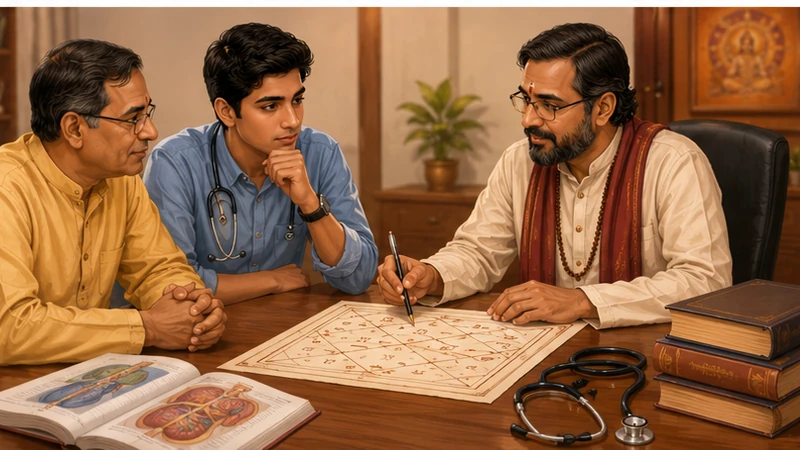
When Personalised Kundli Analysis Becomes More Useful
General information may be enough when the student is simply curious about the planets and houses commonly associated with medicine.
Personalised analysis becomes more useful when the decision is immediate, emotionally important or difficult to resolve.
A full reading may help when the chart contains both supportive and conflicting combinations. It may show strong scientific ability but uncertainty about clinical work, or strong healing tendencies without support for a long medical degree.
It can also be useful when a student is choosing between medicine and another profession, such as research, pharmacy, psychology, engineering, biotechnology or hospital administration.
Repeated delay is another reason to examine the complete chart. The issue may concern timing, competition, educational continuity, confidence, health, finances or a need to reconsider the exact medical path.
Personalised analysis may also help distinguish between becoming a physician and entering another healthcare profession. General online rules often treat every medical indicator as doctor yoga, even though the chart may point toward diagnostics, therapy, research, nursing, pharmacy or management.
The purpose of a detailed reading should be to create clarity rather than fear. It should explain the chart’s strengths, limitations, possible alternatives and practical direction without promising a guaranteed result.
Would Personal Kundli Guidance Help?
If you are trying to decide whether medicine is the right career, general doctor-yoga information may not answer every part of the question. A personalised kundli analysis can examine the complete combinations, educational potential, professional direction and timing more carefully.
For personalised guidance, use the WhatsApp icon in the footer below.
An astrological yoga to become a doctor can indicate potential for medical education, healing, service, analysis or specialised work. Yet the final outcome depends on the complete chart, the operating period, personal aptitude, educational opportunity and sustained effort. General combinations can provide useful direction, but an important career decision deserves both practical evaluation and chart-specific understanding.
Frequently Asked Questions About Doctor Yoga in Astrology
Which planet is responsible for becoming a doctor?
No single planet is solely responsible for becoming a doctor. Mars may support surgery and technical action, Mercury may support diagnosis and analysis, Jupiter may support knowledge and judgment, and the Moon may support care and sensitivity. The final conclusion depends on how several planets connect with education, medical and professional houses.
Which house indicates a medical profession in astrology?
The sixth house is commonly associated with disease, treatment and service, but it cannot confirm a medical profession alone. The fifth and ninth houses may support education, the eighth house may support research or surgery, the tenth house represents profession, and the twelfth house may connect with hospitals. Their combined relationship is more important than one house.
Can one planetary yoga guarantee that someone will become a doctor?
No. One planetary yoga cannot guarantee a medical career. The combination must be supported by the complete birth chart, relevant divisional charts, dasha, education, personal interest and real-world qualifications.
Does Mars indicate a career as a surgeon?
Mars can support courage, technical action, blood-related work and the use of sharp instruments, so it is often considered in surgical combinations. However, Mars must connect constructively with education, profession and medical houses. Mars alone does not confirm that someone will become a surgeon.
Can a kundli indicate medical specialisation?
A kundli may suggest broad tendencies toward surgery, diagnostics, patient care, research, reproductive health, psychology or other medical areas. These indications must be compared with the person’s academic strengths, interests and available training. Astrology should not be the only basis for selecting a specialisation.
Is the D10 chart important for judging a medical career?
The D10, or Dashamsha chart, is useful for examining professional development, responsibilities and career expression. It should be studied with the birth chart rather than independently. Educational support may also be assessed through the D24 chart, while the D9 can help confirm the deeper strength of important planets.
Can astrology predict success in a medical entrance examination?
Astrology may indicate whether a period is supportive, competitive, delayed or demanding, but it cannot guarantee an examination result. Preparation, health, accuracy, competition and actual performance remain decisive.
What if doctor yoga is present but the person lacks interest in medicine?
The presence of a promising combination does not require the person to become a doctor. The same planetary qualities may be expressed through research, healthcare, psychology, pharmacy, diagnostics, teaching or another service-oriented profession. Personal interest and aptitude should always be respected.