
Face Reading: Understanding Personality, Nature and Life Tendencies
Face reading is a traditional method of observing facial structure, expressions and overall balance to understand possible personality traits, emotional patterns and behavioural tendencies. It does not provide a complete judgment of a person, but it may offer useful clues when interpreted carefully.
Many people become interested in face reading when they are trying to understand someone better. The question may arise before marriage, during relationship confusion, while evaluating trust, or when a person’s behaviour seems difficult to understand.
General face reading meanings can be interesting and helpful, but they should not be treated as final conclusions. The same facial feature may appear in two people while their nature, upbringing, experiences and behaviour remain completely different.

What Is Face Reading and Why Do People Look for It?
Face reading involves observing the forehead, eyes, eyebrows, nose, lips, cheeks, chin, jawline and natural expressions. Traditional interpretations often connect these areas with thinking style, confidence, emotional sensitivity, communication habits and practical behaviour.
People usually search for face reading because they want clarity about personality. They may want to know whether someone is emotionally open, reserved, dependable, ambitious, practical, sensitive or difficult to understand.
This interest often becomes stronger when an important decision is involved. A person may be considering marriage, entering a partnership, dealing with repeated misunderstandings or trying to understand why someone responds in a particular way.
Face reading should not be confused with making instant judgments based on appearance. A serious interpretation looks at the complete face, the relationship between different features, natural expressions and the person’s overall manner.
What Can Face Reading Reveal About a Person?
Traditional face reading may offer clues about how a person thinks, communicates and reacts emotionally. It may also suggest whether someone tends to be cautious, expressive, independent, disciplined, sensitive or strongly influenced by other people.
These interpretations are based on combinations rather than one isolated feature. For example, the eyes may suggest emotional expression, while the jawline may be associated with firmness. The complete meaning depends on how these features appear together.
Natural expressions are also important. A face at rest may show a different quality from a face during conversation, stress or happiness. This is why one photograph may not always provide enough information for a balanced interpretation.
A person’s age, health, lifestyle and experiences can also affect facial appearance. Any responsible reading should therefore remain practical and avoid dramatic predictions or fixed labels.
How Different Facial Features Are Commonly Interpreted
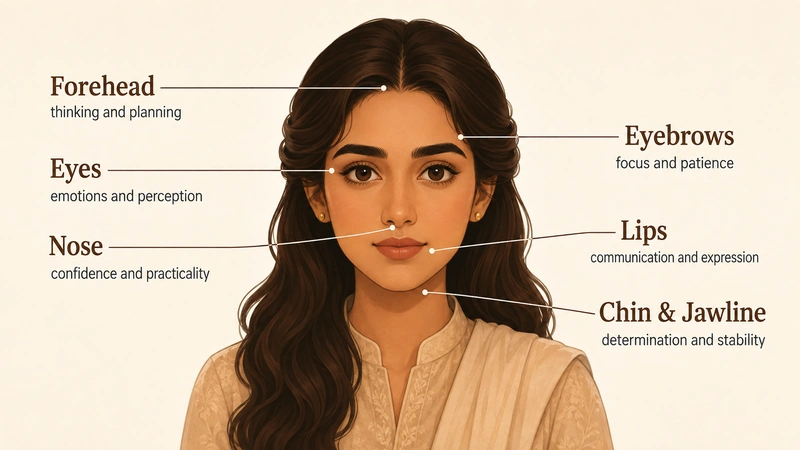
The forehead is traditionally associated with thinking, planning and mental approach. A broad or prominent forehead is sometimes linked with analysis and imagination, while a smaller forehead may be associated with quicker, more direct decision-making.
These meanings are not absolute. The shape of the forehead should be considered along with the eyebrows, eyes and overall facial proportions. One feature alone should never become the basis of a final conclusion.
The eyes are often considered one of the most expressive areas of the face. They may reveal alertness, emotional openness, confidence, hesitation or sensitivity through their movement and natural expression.
Large or expressive eyes are sometimes linked with emotional awareness, while deeper-set eyes may be associated with privacy or observation. These are broad interpretations and can vary considerably from one person to another.
The eyebrows are commonly observed for their shape, spacing and natural movement. They may be associated with concentration, communication style, patience and the way a person processes information.
The nose is traditionally connected with confidence, practical judgment, self-respect and material approach. However, its meaning depends on proportion, balance and how it relates to the rest of the face.
The lips and mouth are often associated with communication, emotional expression and social behaviour. Fuller lips may be interpreted as expressive or affectionate, while thinner lips may be linked with restraint or careful communication.
The chin and jawline are commonly connected with determination, stability and personal firmness. A stronger jawline may suggest persistence, while a softer chin may be associated with adaptability or emotional sensitivity.
These interpretations should always remain balanced. A strong jaw does not automatically mean stubbornness, and expressive eyes do not guarantee emotional openness in every situation.
What Face Reading Can Mean in Real Life
In real life, face reading is often used as an additional way to understand behaviour. It may help a person notice emotional patterns, communication habits or personality tendencies that were previously overlooked.
For example, someone may appear confident in conversation but show signs of hesitation through expression. Another person may seem reserved initially but become warm and expressive after trust develops.
This is why face reading should not be used to judge a person too quickly. Facial structure may suggest a tendency, but actual character is revealed through actions, consistency, values and behaviour over time.
Relationship decisions are especially sensitive. It would be unwise to accept or reject a marriage proposal only because of one facial feature or a general online interpretation.
Face reading may support observation, but it cannot replace honest communication, background understanding, compatibility assessment or practical judgment.
In the same way, it should not be used to label someone as dishonest, aggressive, weak or unreliable. Such conclusions can create unnecessary fear and may damage relationships.
The more important the decision, the more carefully the information should be used. General interpretations can create awareness, but they should not become rigid rules.
Why General Face Reading Rules Have Limits
A general rule may describe a broad tendency, but it does not explain the complete personality. Two people with similar facial structures may behave very differently because of their upbringing, responsibilities, emotional experiences and personal choices.
Temporary conditions can also affect appearance. Stress, illness, tiredness, age and lifestyle may change facial expression, skin tone and overall presentation.
Photographs can be misleading because lighting, camera angle and facial pose can alter how features appear. A serious face reading is more reliable when the face can be observed naturally rather than through one edited picture.
Traditional face reading is an interpretive practice, not a medical or scientific diagnostic method. It should not be used to diagnose health, mental state or future behaviour.
This is where detailed personal interpretation becomes important. The full face, expressions, life situation and purpose of the reading should be considered together. A general rule may not tell the full story, and one isolated sign should never be treated as the final conclusion.
If face reading is being considered alongside astrology, the complete horoscope may provide a separate layer of context. Even then, one system or one feature should not be treated as the final answer.

When Personalised Guidance Becomes More Useful
General information is usually enough when the purpose is simple curiosity. It can help someone understand what different facial areas traditionally represent and why overall balance matters.
Personalised guidance becomes more useful when the concern is emotionally important. This may include marriage, relationship uncertainty, trust issues, family decisions or repeated confusion about someone’s behaviour.
A personal reading can focus on the exact concern instead of applying the same general meaning to everyone. It may also explain which observations are more significant and which should not be overemphasised.
The purpose should be to create clarity, not fear. A useful interpretation should remain realistic, respectful and connected to practical behaviour.
Would Personal Guidance Help Your Situation?
If you are trying to understand an important concern involving marriage, trust, relationships or a personal decision, general information may not answer every part of the situation. Personalised guidance can help separate useful observations from assumptions and provide a more balanced direction.
For personalised guidance, use the WhatsApp icon in the footer below.
Face reading may offer insight into personality and emotional tendencies, but it should always be interpreted carefully. General meanings can be useful, yet exact understanding requires the complete face, natural expressions and the real-life situation to be considered together.
Frequently Asked Questions About Face Reading
What is face reading?
Face reading is a traditional interpretive practice that observes facial structure, expressions and overall balance. It is commonly used to understand possible personality traits, emotional tendencies and behavioural patterns. It should be treated as a supportive method of observation rather than a complete judgment of a person.
Can face reading reveal personality?
Face reading may offer clues about personality, communication style, emotional expression and practical tendencies. However, it cannot reveal every part of a person’s character. Real behaviour, upbringing, values and life experiences remain equally important.
Is face reading enough to judge a person completely?
No. Face reading alone should never be used to judge someone completely. One facial feature or one photograph cannot explain a person’s full nature. Important decisions should also consider behaviour, communication, consistency and practical compatibility.
What facial features are commonly observed in face reading?
Traditional face reading commonly observes the forehead, eyebrows, eyes, nose, lips, cheeks, chin and jawline. Natural expressions and the overall balance between features are also important because isolated features can easily be misunderstood.
Can face reading help in relationships or marriage decisions?
Face reading may offer additional insight into emotional expression, communication and personality tendencies. However, it should not replace Kundli Matching, honest discussion, family understanding or practical compatibility. Marriage decisions should never depend on one feature or one general interpretation.
When should someone seek personalised face reading guidance?
Personalised guidance may be useful when the concern involves marriage, trust, relationship confusion or an important personal decision. A detailed interpretation can consider the full face, natural expressions and the specific situation more carefully than general online meanings.